I haven’t
posted in a while, but I’ve got a pretty good excuse. I had visitors! My mom
and Grandma came to Paraguay for a little over two weeks to get a glimpse of my
life here as well as to see some of the history of Paraguay. It was an amazing
trip, and I couldn’t be more grateful for their visit.
My part of
the trip began about 3 weeks ago when I left for Asunción via La Encarnacena
(bus) at noon. I arrived in Asunción a little after 6 p.m. with our hotel address
in hand. Unfortunately even with the address the driver still had no idea where
it was, so he stopped to ask two people and called/texted others while driving
to find out. I’m positive we didn’t take the most direct route, but I made it
and survived. Cab drivers in Asunción are crazy, and texting while driving is
nowhere close to the worst part. There were several times during this trip
where we felt sure that we were going to be in an accident, but somehow scathed
by with nothing.
Our hotel,
Hotel Royal Gardens, was a pleasant surprise, nothing fancy, but super cute, and the front desk
staff was extremely nice. They let me ride with them to the airport to pick up
mom and grandma, and the owner was a really interesting guy. I’m pretty sure he
said he was American (sounded like a very native Spanish speaker to me) or at
least he lived in the US for at least 30 years (working in the casino and
beauty shop businesses), lived in London for 5 years and has lived in Paraguay
for the last 30 years although he. He said my Spanish was pretty good, but I’m
sure I made him eat his words quite a few times during the next few days.
Our first
day, we visited Caacupé (Caw-koo-pay),
the spiritual capital of Paraguay. The
legend of Caacupé goes that there was a native named José who lived in the
Franciscan Reduction of Tobatí and was being hunted by natives from another
tribe in the forest. As he was hiding he made a promise to Mary that if his
life was saved he would carve a statue of the Virgin from the wood of the tree
he was hiding behind. When his life was spared, he carved two identical virgins
(one for the church in Tobatí and another for his personal worship). The larger
statue remains in the church at Tobatí and the smaller one can be found in the
basilica in Caacupé. The feast day of the Virgen of Caacupé is celebrated on
December 8, the same as the Immaculate Conception, and around one million
people travel to the basilica to make the pilgrimage some walking all the way
from Asunción.
One would
think that a bus that says Caacupé on the top goes to Caacupé and stops. And that's where you'd be wrong…As we were on the bus I saw a sign that said Caacupé and something
about the basilica. Being a novice Paraguayan bus rider at this point, I figured
that we would be stopping at some sort of terminal. We continued to ride the
bus out of town ( probably for at least 5 or 10 more minutes) with all of us
thinking we must just be making some sort of loop before coming back to the
city center. As I start to look around and make eye contact with the bus driver,
he kindly told me that yes, we had indeed passed Caacupé and needed to get off
to take another bus. Oops! On our way back to Caacupé we got on one of the most
crowded buses I’ve ever been on. Mom was standing right next to the door, which
the driver didn’t close because he either thought he couldn’t or didn’t want to
stifle the bus more than it already was. So, when at the next stop there were
three people waiting I thought no way. However, the driver summoned them on. He
finally drew the line when a man with a huge basket of Chipa tried to get on.
Thank goodness. At this point I’m pretty sure mom was practically sitting on
his shoulder.
 |
| Mom & Grandma's first of many Paraguaany bus rides. |
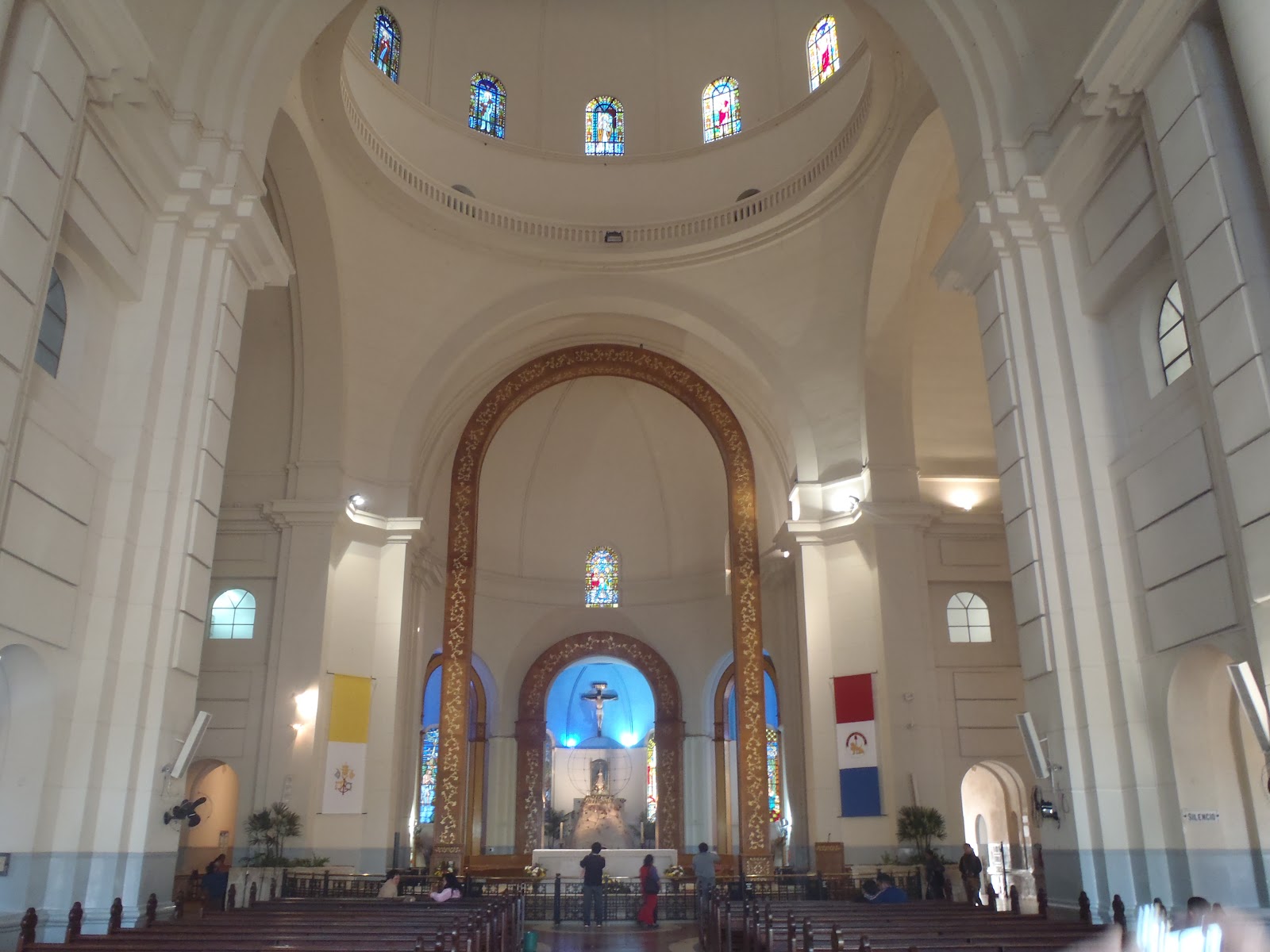
The basilica
was beautiful, and I’m pretty sure we spent more time there than the average
person, partly because I read/translated all of the signs (with the help of my
dictionary) and story of the Virgin that was depicted and told as we climbed
the stairs to the rotunda, and I am unfortunately not quite as fast as Google
Translate.
 |
| The basilica at Caacupé. |
 |
| The stained glass window depicting the story of the Virgen de Caacupe. |
 |
| One of the images on the way up to the rotunda explaining the story. |
 |
| View from the rooftop. |
We also
stopped by a small chapel and well, the Tupãsý Ykuá óé, where the water is supposed
to have healing qualities.
Day two
began at the U.S. Embassy because I needed to add pages to my passport. It was
nothing what I expected and to be honest a letdown. I didn’t even talk to a
single American! The two people that helped me were Paraguayan contractors and
though they spoke English, it just wasn’t the same. There was however, a very
American U.S. citizen (that we assume was married to a Paraguayan) wearing a Pittsburgh
Steelers sweatshirt and baseball cap.
Upon walking into the embassy he said, “Man it really sucks when you don’t see George
W. Bush’s photo on the wall,” as he saw the photo of President Obama. Later,
his wife told him in Spanish to get number. His reply, “I got my numero.” Spanglish
in its truest form. They both obviously understood everything the other was
saying, but each spoke pretty much in their native tongue. Loved it. I wasn’t
allowed to take photos of the embassy even from the street, although I did
quickly snap one which led to some finger shaking from the (Paraguayan) guards.
Regardless of the letdown, I now have 26 more pages to fill! However, I’m
pretty sure people are scared to stamp them because so far they’ve just looked
at them and then squeezed stamps onto other pages that in my opinion are
already full.

From the embassy we hopped on a city bus and headed downtown to see the sights.
We stopped by the Plaza Uruguaya first, and then moved onto the Estación de
Ferrocarril (the old train station), the Plaza de los Héroes for souvenirs, the
Panteón, the Casa de la Independencia museum, Manzana de la Rivera museum,
Palacio de Lopez, Plaza de Marzo Paraguayo, Cabildo, the Cathedral and then to
the same restaurant where Caitlin and I went the last time we were in Asunción
for a delicious lunch. My first Caesar salad in 6 months, and it was great!
After lunch we headed a little bit outside the city center and stopped by La Encarnación
Church. From there we continued to walk even further to find the Jesuit Cristo
Rey Church. After much walking and only finding the school, I made the
executive decision to head back to the hotel for a much needed dinner (a girl
with limited Spanish can only translate and ask questions to strangers for so
long). We hopped on a city bus again and made it back to the hotel in one
piece, although a nice lady did tell Grandma to hide her gold cross necklace
because someone might try to yank it off—a little reality check for Mom and
Grandma. I think one of the things I’m most proud of from our trip is our
ability to master public transit and the crowded buses of Asunción. It is no
small feat, and considering my guide book only mentions specific buses to take
for the airport we were amazing. With no signs or vocal indications of where
you’re arriving and having my space invaded on a constant basis we did good.


Our hotel
was in a nice quiet neighborhood, Las Carmelitas, (an American consulate and
French consulate lived a few houses down) and it was close to the newer (and
nicer) part of Asunción. If you only saw that part you wouldn’t even know you
were in Paraguay, not what I was expecting, but we headed to a Mexican
restaurant and although the Paraguayan take on Mexican food is different from
what I experienced in New Mexico and definitely from the TexMex we call Mexican
in the rest of the States it was delicious. And, our margarita was the perfect
way to top off the night.
Day three we
headed to Luque, Itá and Yaguarón. Luque is known for harps, guitars and silver
filigree. It was a cute town with a picturesque church. I introduced Mom and
Grandma to Amandau too, a Paraguayan ice cream chain, that I and the sisters
frequent.


From Luque (after asking at least five different people including
another bus driver) we hopped on the most crowded bus I’ve ever been on (people
were literally hanging out the door) to Itá. After about 20 minutes Mom and
Grandma were able to score some seats, but I had to stand for the remaining 20
minutes. Luckily though, I met a young girl, Joanna, who I had a great
conversation with and who helped us know when it was time to get off. We
learned our lesson in Caacupé. Our visit to Itá was short (it’s known for its
ceramic pottery), mainly just to see the church that is dedicated to Saint
Blaise. However, once we got to the church we realized there was a funeral going
on so we snapped a few pictures of the outside and headed back to catch another
bus.
It was a quick ride to Yaguarón, in comparison, and I struck up another
conversation with someone to ensure that we got off at the right spot. The church
in Yaguarón is definitely the main attraction and rightly so. It is beautiful.
It is the original church from the Franciscan Reductions that were founded
around 1586. The church was restored in the 1880s and again in the 20
th
century. The wood carvings and painted ceilings are impressive to say the
least. It was by far my favorite church that we saw.
Sunday we
headed to Encarnación after doing the day’s readings in our hotel by ourselves
as we were unsuccessful in finding a nearby church that was having Mass.
Masstimes.org isn’t quite as up-to-date in Paraguay as in the U.S. and we
learned that unlike in the U.S. where most churches post Mass times outside
it’s not always the custom in Paraguay.
Click
here or visit my
Photos page to see my whole facebook album of photos from our trip because uploading them how I want them on my blog just takes WAY too much time.